From Indie Obscurity to Global Phenomenon
Among Us is one of gaming's most improbable success stories. Developed by InnerSloth, a tiny studio of just three people, the game was released in June 2018 to almost no fanfare. For nearly two years, it languished in relative obscurity, attracting a small but dedicated player base while the gaming world's attention was focused elsewhere. Then, in the summer of 2020, everything changed.
As the global pandemic forced millions of people indoors, content creators and streamers discovered Among Us and began broadcasting it to massive audiences. Twitch streamers, YouTube personalities, and even public figures like U.S. Representative Alexandria Ocasio-Cortez played the game on live streams watched by hundreds of thousands of viewers simultaneously. Our team watched in real time as Among Us went from a few hundred concurrent players to tens of millions of downloads worldwide, becoming a cultural touchstone that transcended the gaming community entirely.
The Mechanics of Deception
At its core, Among Us is a social deduction game set aboard a spaceship (or other facility) where a crew of players must complete tasks while one or more Impostors secretly work to sabotage and eliminate them. The premise is simple, but the social dynamics it creates are endlessly complex and entertaining.
Crewmates: Trust No One
Crewmates must complete a series of short minigame-style tasks scattered around the map: wiring connections, scanning identification cards, emptying trash chutes, and more. While these tasks are individually simple, they require players to move around the map, creating opportunities for Impostors to strike when crew members are isolated. Completing all tasks before the Impostors eliminate enough players is one of two win conditions for the Crewmate team.
The genius of the Crewmate experience lies in the constant uncertainty. Every other player could be the Impostor, and every encounter in a corridor becomes a moment of tension. Should you follow the suspicious player to see what they're doing, or will that get you killed? Should you report the body you found immediately, or will that make you look guilty?
Impostors: The Art of Deception
Playing as the Impostor is where Among Us truly shines. Impostors must fake completing tasks, strategically eliminate Crewmates, and, most importantly, lie convincingly during discussion phases. The game gives Impostors access to a vent system for quick escapes, the ability to sabotage ship systems to create diversions, and a kill cooldown that forces careful timing.
The psychological dimension of Impostor play is what elevates Among Us beyond simple party game territory. Successful Impostors must manage suspicion, build false alibis, redirect attention toward innocent players, and know when to stay silent versus when to speak up. This social manipulation creates moments of genuine drama and comedy that few other games can match.
Discussion and Voting: Where the Magic Happens
The discussion phase is the beating heart of Among Us. When a body is discovered or an emergency meeting is called, all surviving players gather to debate who the Impostor might be. In voice chat or text, players share alibis, report suspicious behavior, form alliances, and make accusations. The phase ends with a vote, and the player with the most votes is ejected from the game.
These discussions produce some of gaming's most memorable moments. Innocent players desperately trying to prove their innocence, Impostors coolly deflecting suspicion onto others, and the chaotic energy of multiple people talking over each other create an experience that is simultaneously tense, hilarious, and deeply social. From our experience playing, it's this discussion mechanic that made Among Us a perfect streaming game. Viewers are just as engaged in the social dynamics as the players themselves.
Maps: Evolving the Experience
Among Us launched with a single map, The Skeld (a spaceship), and has since expanded to five distinct environments, each offering unique strategic considerations.
- The Skeld: The classic map, compact and well-balanced, featuring the iconic reactor, electrical room, and security cameras.
- MIRA HQ: A high-rise headquarters with a more open layout and a sensor log system that tracks player movements.
- Polus: A sprawling research station with outdoor areas, making it easier for Impostors to find isolated targets.
- The Airship: The largest map, based on a Henry Stickmin setting, with multiple floors and spawn locations that add complexity.
- The Fungle: A jungle-themed map that introduced new task types and environmental mechanics, refreshing the core gameplay loop.
Peak Popularity
At its peak in September 2020, Among Us had nearly 4 million simultaneous players and was downloaded over 100 million times on mobile devices alone. It was the most-downloaded mobile game in the United States for several consecutive weeks.
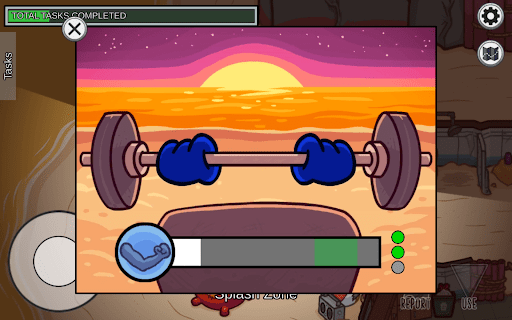
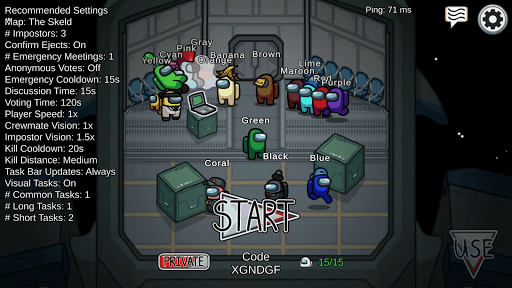
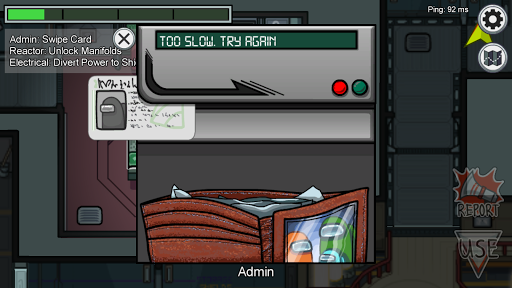
Gameplay screenshots
The Roles Update: Adding Depth
One of the most significant updates to Among Us was the introduction of specialized roles that add new layers of strategy and deception. These roles move beyond the simple Crewmate/Impostor binary and give players unique abilities that fundamentally change how the game is played.
The Scientist can check the vital signs of other players remotely, the Engineer can use vents like an Impostor (providing an alibi or creating confusion), the Guardian Angel can protect players from kills after being eliminated, and the Shapeshifter (an Impostor role) can temporarily disguise themselves as other players. Our reviewers found these roles create fascinating new dynamics: an Engineer using vents might be mistaken for an Impostor, while a Shapeshifter can frame innocent players in ways previously impossible.
Hide and Seek Mode
The Hide and Seek mode represents a fundamental departure from the traditional Among Us formula. In this mode, the Impostor's identity is revealed from the start, transforming the game from a social deduction experience into a thrilling cat-and-mouse chase. Crewmates must complete their tasks while avoiding the known hunter, and the Impostor must track down and eliminate everyone before they finish.
This mode appeals to players who prefer action over discussion and provides a refreshing alternative when groups want a change of pace from the standard format. It also makes the game more accessible to younger players who might find the social deduction aspects challenging.
Why It Became a Cultural Phenomenon
Among Us's viral success wasn't just about being the right game at the right time, though the pandemic's timing certainly helped. The game possesses several qualities that made it uniquely suited for mass cultural adoption.
First, its accessibility is remarkable. The game runs on virtually any device, from low-end smartphones to gaming PCs, and its simple controls mean anyone can play within minutes. There's no complex skill gap separating experienced players from newcomers. Success depends on social skills, not reaction time or mechanical expertise.
Second, it's inherently social. Unlike most multiplayer games where interaction is optional or incidental, Among Us requires active communication. This makes it an ideal bonding activity for friend groups, families, and even coworkers, filling a social void during a time of widespread isolation.
Third, it generates stories. Every game of Among Us produces a unique narrative: the perfectly executed double kill, the innocent player falsely accused, the Impostor who talked their way out of certain ejection. These stories are inherently shareable, fueling the game's spread across social media platforms.
The Streaming Effect
Among Us's relationship with streaming and content creation has been symbiotic. The game's social dynamics are inherently entertaining to watch, and streamers' reactions to betrayals, arguments, and clever plays create compelling content. Korean and Japanese streamers initially drove early interest, followed by major English-language creators like PewDiePie, Pokimane, and Corpse Husband, whose Among Us content routinely attracted millions of views.
The streaming boom also introduced the concept of "proximity chat" mods, where players could only hear others who were physically nearby in the game. This added an entirely new dimension to the experience, allowing for whispered conspiracies, overheard conversations, and dramatic reveals that made both playing and watching even more engaging.
InnerSloth's Journey
The success of Among Us transformed InnerSloth from a tiny indie studio into a significant player in the gaming industry. The team expanded from three to over twenty employees, allowing them to pursue more ambitious updates and features. Despite the pressure of sudden fame, InnerSloth has maintained a community-first approach, communicating transparently about development progress and prioritizing player feedback in their update schedule.
The studio's journey serves as an inspiration for independent developers everywhere. It's proof that a small team with a brilliant concept can compete with the largest studios in the world, and that a game's success isn't determined at launch but by the quality of the experience it provides.
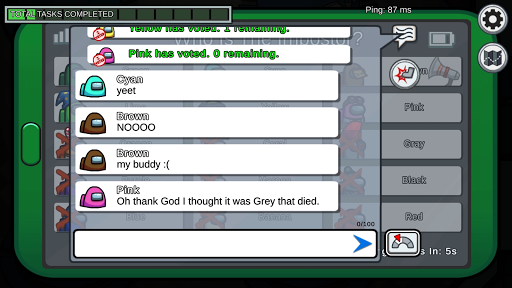
In-game action
Legacy and Lasting Impact
Even as the initial hype has settled, Among Us has secured its place in gaming history. It popularized the social deduction genre for mainstream audiences, spawned countless imitators, and inspired games across multiple platforms. The game continues to receive regular updates, and its core community remains active and passionate. In our honest assessment, Among Us proved that games don't need cutting-edge graphics or massive budgets to capture the world's imagination. They just need to understand what makes playing together fun.