What Exactly is Asphalt 9: Legends?
There's something undeniably thrilling about flooring a Lamborghini Aventador through the streets of Cairo, drifting around a hairpin at 300 km/h, launching off a ramp, and barrel-rolling through the air before nailing a perfect landing — all while your phone fits comfortably in your back pocket. That, in a nutshell, is Asphalt 9: Legends. It's ridiculous. It's over the top. And honestly? It's absolutely glorious.
Gameloft's flagship racing franchise has been a staple of mobile gaming for over a decade, and Asphalt 9 represents the pinnacle of everything the studio has learned about delivering console-quality racing experiences on touchscreens. Released in 2018, it arrived with a graphical punch that genuinely shocked players. Even years later, it remains one of the most visually impressive mobile games ever made, and the gameplay loop is every bit as addictive as the visuals suggest.
I've spent a frankly embarrassing amount of hours with this game — we're talking hundreds of races across career mode, multiplayer seasons, and limited-time events — and I still find myself reaching for it during lunch breaks and airport layovers. Let me walk you through everything that makes Asphalt 9 such a standout title, and where it occasionally slips off the track.
Gameplay: Accessible Chaos with Hidden Depth
Asphalt 9 offers a choice that shapes your entire experience from the moment you launch your first race: TouchDrive or manual controls. TouchDrive is Gameloft's semi-automatic steering system where the game handles acceleration and basic navigation while you swipe left and right to choose lanes, tap to activate nitro, and time your drifts. Manual controls give you traditional tilt or tap-to-steer input with full control over every aspect of driving.
Here's where it gets interesting. TouchDrive was controversial when the game launched, with hardcore racing fans dismissing it as "auto-play." But I'd argue it was a stroke of genius. It lowered the barrier to entry massively, letting casual players enjoy the spectacle without fighting clunky virtual joysticks. The real depth reveals itself when you switch to manual — suddenly you're threading needles between obstacles, finding shortcuts the AI-assisted system would never choose, and shaving precious tenths off your lap times.
The core racing mechanics emphasize spectacle above all else. Every track is loaded with ramps that launch you into barrel rolls and 360-degree spins. Nitro management is crucial — you build it through drifting, performing stunts, and knocking out opponents. A perfectly timed nitro boost while airborne triggers a "Perfect Nitro" that gives you a longer, more powerful burst. It's the kind of system where you're always chasing the optimal line, not just the fastest one, but the most stylish one.
Knockdowns add a combat element to races. Slamming into opponents at the right angle sends them spinning off the track, temporarily eliminating them. It's immensely satisfying and adds a layer of aggression that turns races into chaotic, unpredictable events. If you've ever played Subway Surfers and loved the reflexive dodging and split-second decision-making, Asphalt 9 channels that same energy but at ten times the speed.
A Garage of Dreams
The car roster in Asphalt 9 is genuinely impressive, featuring licensed vehicles from manufacturers like Lamborghini, Ferrari, Porsche, Bugatti, McLaren, Aston Martin, W Motors, and more. At the time of writing, there are over 150 cars in the game, ranging from accessible daily drivers to exotic hypercars that represent months of gameplay investment.
Cars are organized into classes — D, C, B, A, and S — with each class featuring progressively faster and more exotic machines. Progression works through a "blueprint" system: you collect car-specific blueprints from races, events, and the store, and once you have enough, you can unlock or "star up" the vehicle. Each star level increases the car's maximum stats and unlocks new upgrade tiers.
The Star System
The star upgrade system is both the backbone of Asphalt 9's progression and its most debated feature. Maxing out a top-tier car can take months of dedicated play, which gives long-term players clear goals to chase. But it also means there's a significant gap between newly unlocked cars and fully upgraded ones, which can be frustrating in competitive multiplayer when you're matched against veterans with golden max-star hypercars.

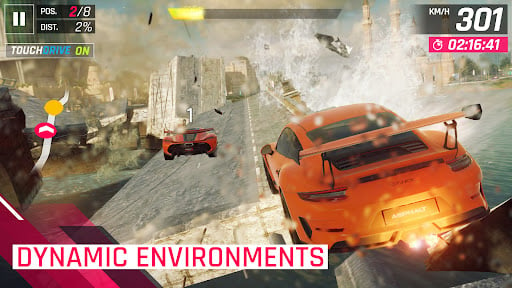
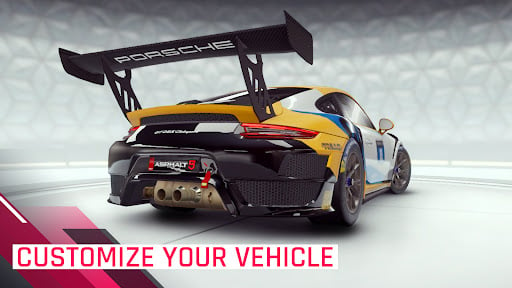
The garage and racing action in Asphalt 9: Legends
Graphics and Presentation: A Visual Benchmark
Let's be direct about this: Asphalt 9 is, in my honest opinion, the best-looking racing game on mobile. Full stop. The game runs on Gameloft's proprietary engine and it squeezes every last polygon out of modern smartphone hardware. Car models are detailed and accurately rendered, with reflective paint, visible interior cockpits, and damage modeling that shows scratches and dents during races.
But the tracks are where the visual design truly shines. Each location — from the sun-drenched coastal roads of the Caribbean to the rain-soaked streets of Osaka at night — is packed with environmental detail and dramatic set pieces. You'll race through collapsing tunnels, dodge tornadoes, launch off the deck of an aircraft carrier, and drift through ancient ruins. It's absurd and wonderful.
The HDR lighting deserves special mention. The way sunlight filters through clouds and bounces off wet asphalt creates genuinely atmospheric moments. When you hit a nitro boost and the camera pulls back slightly with motion blur streaking across the screen, it creates a sense of speed that's almost visceral. I've caught myself grinning during races more times than I care to admit.
Sound design complements the visuals perfectly. Engine sounds are differentiated between car types, tire screeches feel appropriately urgent, and the soundtrack — a mix of electronic and orchestral tracks — keeps the energy high without becoming monotonous. Compared to Temple Run 2's more ambient soundscape, Asphalt 9 is a full-blown sensory assault.
Performance Note
Asphalt 9 offers adjustable graphics settings on most devices. On flagship phones, the game runs at high resolution with full effects. Older devices can scale down to maintain smooth framerates. We tested on multiple devices and found the game remarkably well-optimized across the board.
Career Mode and Events
The single-player career mode is structured across chapters, each requiring specific car classes. Early chapters introduce you to D and C-class cars while teaching the basics, gradually ramping up the difficulty and introducing more demanding race types. There are standard races, time-limited challenges, and "hunt" events where you chase a target car to earn blueprints.
What keeps the career mode engaging long-term is the sheer volume of content. There are hundreds of individual events, and Gameloft regularly adds new seasons with fresh chapters. The challenge level scales well — early events are approachable, but later chapters require maxed-out cars and near-perfect racing lines, giving skilled players genuine goals to pursue.
Daily and weekly events add variety and urgency. Limited-time car hunts, special seasonal events, and collaboration events (they've partnered with brands like Hot Wheels and Lamborghini for special occasions) keep the game feeling alive and constantly evolving. There's always something new to chase, some new car to unlock, some new challenge to attempt.
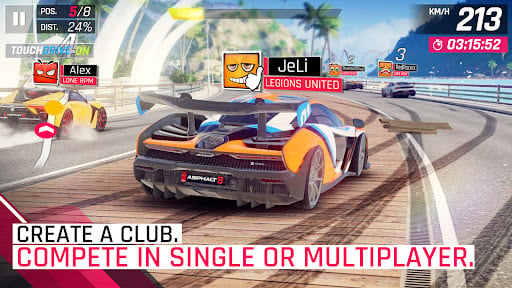
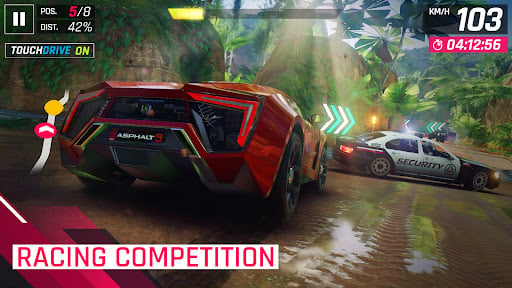
Career progression and multiplayer racing in Asphalt 9
Multiplayer: Where the Real Racing Lives
Online multiplayer is where Asphalt 9 reveals its competitive teeth. Ranked seasons run on regular cycles, matching you against players of similar rating. Climbing the ranks requires not just fast cars but genuine skill — knowing when to nitro, when to knockdown, when to take a risky shortcut, and when to play it safe.
Club features add a social dimension. Joining a club gives you access to club races, milestones, and rewards that incentivize regular play. It's a smart system that creates community without demanding the time commitment of a guild in an MMO. You contribute at your own pace, and the collective progress benefits everyone.
Limited-time multiplayer events, like Grand Prix seasons that focus on specific cars, add stakes and variety. These events often require strategic car investment, as you need a particular vehicle at a competitive level to participate. They're some of the game's most thrilling content, with top-tier rewards for the best performers.
The Elephant in the Garage: Monetization
I can't write an honest review of Asphalt 9 without addressing its monetization model, because it's the game's most significant weakness. The blueprint-based progression system, while functional for free players willing to grind, is clearly designed around encouraging purchases. Energy systems (fuel tanks) limit how many races you can run consecutively, and premium currency can accelerate everything from car unlocks to upgrades.
The Legend Pass (the game's premium battle pass) offers excellent value for invested players, providing exclusive cars, blueprints, and resources throughout its season. But the rotating store, with its real-money car packs and limited-time offers, can feel aggressive. Gameloft walks a fine line here — the game is absolutely playable without spending a dime, but the path to top-tier cars is significantly longer for free-to-play players.
That said, Gameloft has improved the economy over the years. Events are more generous with rewards, and the addition of more accessible cars in each class means free players can compete meaningfully in multiplayer without the most expensive vehicles. It's not perfect, but it's better than it was at launch.
Pros and Cons
What We Love
- Absolutely stunning graphics that push mobile hardware to its limits
- Massive licensed car roster with over 150 vehicles from real manufacturers
- TouchDrive and manual controls cater to all skill levels
- Extensive career mode with hundreds of events
- Exciting, well-structured competitive multiplayer
- Consistently updated with new cars, tracks, and events
- Incredible sense of speed and spectacle
What Could Improve
- Fuel/energy system limits play sessions without waiting or paying
- Blueprint grinding for top-tier cars can feel excessively long
- Aggressive in-game store with frequent pop-up offers
- Multiplayer matchmaking occasionally pits upgraded cars against stock versions
- Large download size and frequent updates consume significant storage
Final Verdict
Asphalt 9: Legends is, without question, the king of arcade racing on mobile. Its visual quality is unmatched, its car roster is a gearhead's fantasy, and its moment-to-moment gameplay delivers the kind of cinematic thrills that make you forget you're playing on a phone. The career mode offers months of content for solo players, while the multiplayer provides genuinely competitive racing for those who want to test themselves against others.
The monetization model holds it back from true greatness — the fuel system and blueprint grind can be frustrating, and the constant store notifications are an unwelcome distraction. But if you can look past those irritations, or better yet, if you're patient enough to play at the game's intended free-to-play pace, you'll find one of the most polished and rewarding mobile games in any genre.
If you enjoy physics-based racing games, you might also want to check out Hill Climb Racing 2 for a completely different but equally addictive take on mobile racing. For something more grounded and strategic, it's a great counterpoint to Asphalt 9's bombastic spectacle.