Racking Up the Competition
There's a pool table in virtually every bar on the planet, and there's an 8 Ball Pool app on virtually every smartphone. Miniclip's billiards juggernaut has been downloaded over 800 million times since its initial release in 2013, and in the world of mobile pool games, it isn't just the market leader — it's the market itself. Competitors exist, sure, but talking about mobile billiards without talking about 8 Ball Pool is like discussing smartphones without mentioning the iPhone. It's the reference point against which everything else is measured.
What makes this dominance so remarkable is that 8 Ball Pool achieves it with a concept that sounds almost comically simple: play pool against other people online. No zombies. No magic powers. No battle royale mechanics. Just you, a cue stick, some balls, and an opponent somewhere across the world who thinks they're better than you. Spoiler: they might be. And that competitive tension is exactly what has kept millions of players coming back for over a decade.
The Core Experience: Physics That Feel Right
Let's talk about what matters most in any pool game: how the balls move. 8 Ball Pool nails this. The physics engine simulates spin, english, bank shots, and cushion rebounds with enough accuracy to satisfy serious billiards fans while remaining accessible to casual players who just want to sink some balls. Pull back the cue, adjust your aim using the dotted guideline, add spin if you're feeling fancy, and release. The feedback is immediate and satisfying — the crack of the break, the smooth roll of the cue ball, the thunk of a ball dropping into a pocket.
The aiming system strikes a clever balance between skill and accessibility. Lower-tier tables provide longer aiming guidelines, giving newcomers a generous margin for error. As you progress to higher-stakes tables, the guidelines shrink, demanding more precise geometry and a deeper understanding of billiards angles. This gradual difficulty curve ensures that improvement feels earned rather than purchased — although more on that nuance later.
Compared to something like the real-time competitive intensity of Clash Royale, 8 Ball Pool offers a more cerebral, turn-based form of competition. You're not reacting in split-seconds; you're thinking, planning, calculating angles. It's chess with a cue stick, and that deliberate pacing is a huge part of its appeal.
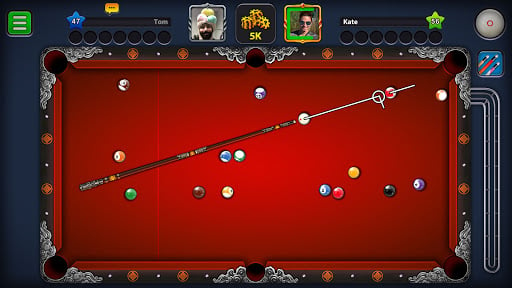
The clean, intuitive interface puts the focus where it belongs — on the table
The Coin Economy: Stakes That Matter
8 Ball Pool's most brilliant design decision is its coin-wagering system. Every match requires both players to put up an equal amount of coins, and the winner takes all. This transforms every game from a casual pastime into something that genuinely matters. When you've wagered 50,000 coins on a match and you're staring at a difficult bank shot on the 8 ball, your palms actually sweat. The stakes create emotional investment that no amount of artificial game design could replicate.
Tables are tiered by coin entry fees, from the beginner-friendly London Pub (50 coins) to the terrifying Berlin Platz (2,500,000 coins). Each table has a distinct visual theme, different coin requirements, and longer or shorter aiming guidelines. The progression is designed so that you naturally graduate from lower tables to higher ones as your skill and bankroll grow. It's a clean, elegant system that mirrors the real-world progression of a pool player moving from friendly bar games to serious money matches.
Managing Your Bankroll
Bankroll management is a skill that 8 Ball Pool never explicitly teaches but ruthlessly punishes if you ignore. A general rule of thumb: never wager more than 10% of your total coins on a single match. Go on a losing streak at a table that's too expensive for your bankroll, and you'll find yourself broke and grinding the lowest tables to recover. I learned this lesson the hard way at the Jakarta table, and I still haven't fully recovered — emotionally or financially.
By the Numbers
8 Ball Pool boasts over 800 million downloads across iOS and Android, making it one of the most downloaded sports games in mobile history. At peak hours, millions of matches are played simultaneously worldwide, with the highest-level tables seeing wagers equivalent to hundreds of hours of grinding.
Comparing 8 Ball Pool to the Competition
8 Ball Pool didn't achieve its dominance in a vacuum. Several competitors have taken shots at the throne over the years. Let's break down how they compare.
Pool Stars (formerly known as Pool Live Tour)
Pool Stars offers a similar online multiplayer experience with arguably prettier visual effects. The ball physics are competent, and the game features trick shot challenges that 8 Ball Pool lacks. However, Pool Stars suffers from a smaller player base, meaning longer matchmaking times and less competitive depth. When you play 8 Ball Pool, you're matched almost instantly against opponents at your skill level. That seamless matchmaking, powered by an enormous player pool, is a competitive advantage that smaller games can't replicate.
Real Pool 3D
Real Pool 3D takes a different approach, emphasizing realistic 3D graphics and a more simulation-focused experience. The camera angles mimic what you'd see in a televised snooker match, and the physics model is arguably more accurate than 8 Ball Pool's. But here's the thing: more realistic doesn't mean more fun. 8 Ball Pool's top-down perspective and simplified controls are better suited to mobile play. You don't want to be adjusting camera angles on a touchscreen during your lunch break. You want to aim and shoot.
Snooker Stars
Miniclip's own sibling game, Snooker Stars, applies the 8 Ball Pool formula to snooker — a more complex sport with more balls and stricter rules. While Snooker Stars is well-made, snooker's inherent complexity makes it less accessible than 8-ball, and the player base reflects this. Snooker appeals to purists; 8-ball appeals to everyone.
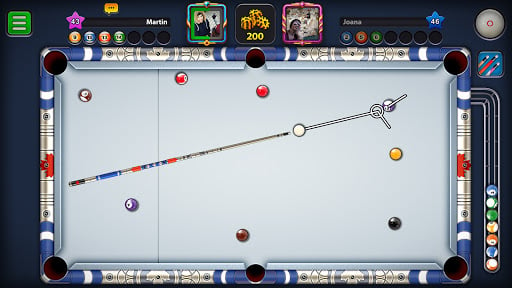
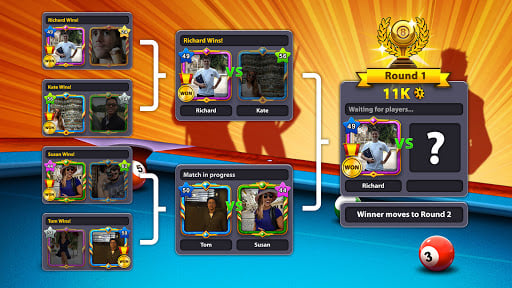

Cues, tournaments, and high-stakes matches — the depth behind the simplicity
Cues and Customization: More Than Cosmetic
8 Ball Pool's cue system adds a layer of strategic depth that's easy to overlook. Cues aren't just cosmetic — each one has stats affecting aim length, power, spin, and time. Higher-tier cues provide tangible in-game advantages, making cue upgrades a meaningful progression goal. You earn cue pieces through gameplay, the Pool Pass season system, and occasional purchases, and assembling a complete premium cue feels like a genuine achievement.
The table customization options are less impactful but no less enjoyable. Changing the felt color, the chat packs, and the victory animations lets you personalize your pool hall identity. It's a small thing, but it contributes to the sense that your 8 Ball Pool account is uniquely yours.
The Competitive Community
What truly sets 8 Ball Pool apart from its competitors is the size and intensity of its competitive community. Weekly tournaments, the Pool Pass season system, and club features create a social ecosystem that extends far beyond individual matches. Joining a club connects you with regular playing partners, enables team competitions, and provides a social hub that keeps players engaged between solo matches.
The competitive scene has its own informal hierarchy. Players in the highest leagues have invested thousands of hours into mastering angles, spin physics, and break patterns. YouTube and TikTok are filled with 8 Ball Pool trick shot compilations and tutorial videos, and the game's top content creators have built substantial followings. It's reminiscent of the community that has formed around Brawl Stars, where dedicated players create an ecosystem of content, strategy, and competition that extends the game's life far beyond its core mechanics.
The Social Fabric: Playing with Friends
8 Ball Pool was one of the first mobile games to truly nail the "play with friends" experience, partly thanks to its roots as a Facebook game. Connecting through Facebook or Miniclip ID lets you challenge friends directly, which transforms the game from a solo competitive exercise into a social ritual. I have group chats that are essentially 8 Ball Pool grudge match scheduling services. "Best of 5 tonight?" "You still owe me from last week's comeback." The social layer turns individual matches into ongoing rivalries with real history.
This social dimension is something that even excellent multiplayer games like Among Us approach differently. Among Us thrives on group dynamics and deception; 8 Ball Pool thrives on one-on-one rivalry and proving your superiority. Both are deeply social, but in fundamentally different ways.
Monetization: The Elephant in the Pool Hall
Let's address the one area where 8 Ball Pool draws legitimate criticism: monetization. The game is free to play and technically allows you to access all content without spending money, but the economy is designed to encourage purchases. Running out of coins means waiting, grinding low-stakes tables, or spending real money. Premium cues with better stats can be seen as pay-to-win advantages. And the Pool Pass, while offering good value, is a recurring cost.
In our assessment, the monetization is aggressive but not game-breaking. Skilled players can absolutely compete without spending, and the matchmaking system generally pairs you with opponents of similar cue quality. But if you're easily tempted by in-app purchases, set a budget before you start — the game is very good at presenting "just one more" spending opportunities.
Final Verdict: Still Running the Table
8 Ball Pool has maintained its position atop the mobile billiards world for over a decade, and for good reason. The physics are satisfying, the competitive structure is deep, the social features are robust, and the player base is so massive that you'll never wait long for a match. Its competitors offer technical alternatives, but none match the complete package that 8 Ball Pool delivers.
Whether you're a casual player looking for quick matches during your commute or a competitive grinder chasing the highest league, 8 Ball Pool has a table with your name on it. Just remember: manage your bankroll, practice your bank shots, and never — ever — underestimate the player with the basic cue. They might just be hustling you.