A Confession: The Birds That Stole My Commute
I need to come clean about something. Back in 2009, I was one of those people who thought mobile games were just glorified time-wasters — little digital distractions for killing five minutes in a waiting room, nothing more. Then a friend showed me this silly game where you launched cartoon birds at green pigs hiding behind structures, and... well, I missed my bus stop. Twice. In the same week.
That game was Angry Birds, and it didn't just change how I felt about mobile gaming — it changed mobile gaming itself. The original Angry Birds, created by a scrappy Finnish studio called Rovio that had been on the verge of bankruptcy, became one of the most downloaded games in history. It spawned movies, merchandise, theme parks, and an empire built entirely on the satisfying physics of smashing pig fortresses with frustrated poultry.
Now, with Angry Birds 2, Rovio has taken everything that made the original a cultural phenomenon and rebuilt it from the ground up. And after spending more time than I probably should launching birds at pigs in 2025, I can tell you that the magic hasn't just survived — it's evolved in ways that genuinely surprised me.
The Origin Story: Why We Fell in Love
To understand why Angry Birds 2 matters, you have to appreciate what the original accomplished. Before Angry Birds, the idea that a simple physics puzzle game could become a worldwide cultural phenomenon was unthinkable. Mobile games were ringtones with extra steps. Rovio changed all of that by nailing three things perfectly: intuitive touch controls, deeply satisfying physics destruction, and characters so charming they transcended the game itself.
The premise was absurdly simple. Green pigs stole eggs from a flock of birds. The birds are angry about this (naturally). You launch them via slingshot at increasingly elaborate pig fortresses, watching structures crumble, glass shatter, and pigs pop with delightful sound effects. It was a game that anyone — literally anyone, from toddlers to grandparents — could pick up and immediately understand.
But beneath that simplicity was real depth. Each bird had unique abilities — Red crashed through structures, Chuck (the yellow one) accelerated to pierce through wood, Bomb exploded on impact, and Matilda (the white one) dropped egg bombs. Mastering the trajectory angles, understanding when to deploy each bird's ability, and finding the optimal point of impact to topple entire structures with a single shot — that was where the game revealed its genius. It was easy to play but fiendishly difficult to three-star every level.
Angry Birds 2: The Same Soul, New Body
Angry Birds 2, released in 2015, isn't just a sequel — it's a reimagining. Rovio rebuilt the game engine entirely, upgrading the physics system, the graphics, and the game structure while maintaining the core loop that made the original so addictive. The birds are the same lovable characters, the pigs are still infuriatingly smug, and the slingshot still feels perfect. But everything around those elements has been modernized.
The most significant change is the multi-stage level design. Instead of single-screen puzzles, levels now consist of multiple rooms, each with its own pig fortress. You work through each room sequentially, carrying your remaining birds forward. This creates a resource-management element that didn't exist in the original — you can't just brute-force early rooms, because you need to conserve birds for what's ahead.
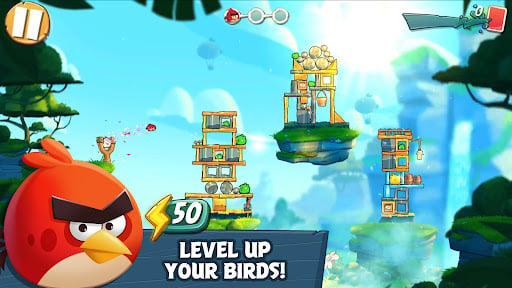
Multi-stage levels bring new strategic depth to the classic formula
The Spell System
Angry Birds 2 introduces spells — powerful abilities that can be used alongside your birds. Spells include Golden Ducks (a rain of rubber ducks that damages everything on screen), Mighty Eagle (the OG nuclear option), Pig Inflater (which expands pigs until they pop), and more. Spells add tactical variety to levels, giving you more tools to approach each puzzle and more options when you're stuck. It's like having a few extra aces up your sleeve, and knowing when to play them adds another layer to the strategy.
Card-Based Bird Selection
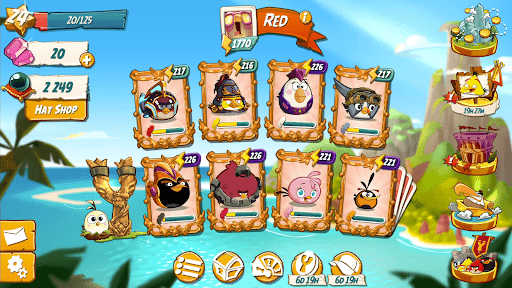
Another major evolution is the card-based bird selection system. Instead of getting a predetermined sequence of birds for each level, you're dealt a hand of bird cards and choose which to launch and when. This seemingly small change dramatically alters how you approach each puzzle. Should you lead with Bomb to blast through that stone wall, or use Chuck to pick off the exposed pigs first? The choice is yours, and it makes every attempt feel unique even on levels you're replaying.
The Birds Themselves: Old Friends, New Tricks
Every classic bird returns in Angry Birds 2, and they all feel refreshed. Red is still your reliable all-rounder, crashing through structures with satisfying impact. Chuck's speed burst is as thrilling as ever, especially when you angle him to tear through multiple wooden platforms. Bomb's explosion now features improved particle effects that make his detonation feel truly devastating. The Blues (those little blue triplets) split into three mid-flight, scattering across the screen to hit multiple targets.
Silver, the newest addition to the flock, brings a looping dive-bomb attack that's incredibly useful for hitting targets from above. Her trajectory — she loops upward and then crashes straight down — takes some getting used to, but once you master it, she becomes essential for dealing with reinforced roof structures that other birds can't easily reach.
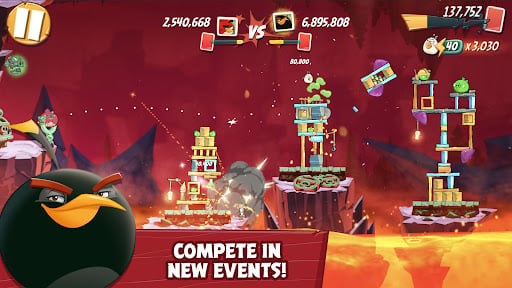
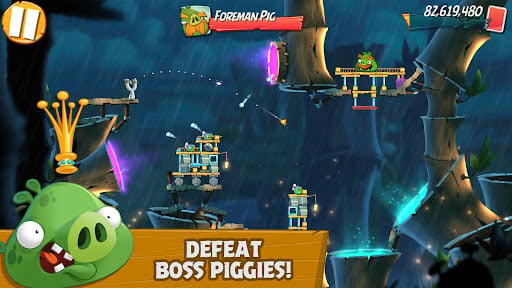
The birds in action: from precise shots to epic boss battles
Beyond the Slingshot: Clans, Events, and Community
Modern Angry Birds 2 has grown well beyond its single-player roots. The Clan system lets you team up with other players to tackle challenges together, competing against rival clans in weekly events. There's something wonderfully absurd about coordinating Angry Birds strategy with a group of strangers on the internet, but the clan competitions are genuinely engaging and provide excellent rewards.
Daily challenges, seasonal events, and the Arena (a competitive PvP mode where you race through levels against another player) keep things fresh. The Arena, in particular, is brilliantly tense — you and your opponent tackle the same multi-room level simultaneously, and seeing their progress bar creep ahead while you struggle with a tricky pig formation creates genuine competitive pressure. It's the kind of feature that makes me think Candy Crush was onto something when it pioneered mobile game social competition, but Angry Birds 2 does it with more personality.
By the Numbers
The Angry Birds franchise has been downloaded over 5 billion times across all titles. The original game alone has been downloaded over 2 billion times, making it one of the most popular mobile games in history. Angry Birds 2 itself has crossed 300 million downloads worldwide.
The Monetization Conversation
I'd be painting an incomplete picture if I didn't mention Angry Birds 2's energy system and monetization. The game uses a "life" system — you have a limited number of attempts before needing to wait for lives to regenerate or pay to continue. It can be frustrating when you're deep into a challenging level and run out of birds, only to be shown a prompt to spend gems or watch an ad.
Compared to Fruit Ninja's relatively unobtrusive approach, or the simplicity of Cut the Rope's level packs, Angry Birds 2's free-to-play model feels more insistent. That said, Rovio has improved the balance over the years — you get more free lives through clan rewards and daily bonuses than at launch, and most levels are completable without spending anything if you're willing to experiment with different bird-and-spell combinations.
The key insight is this: Angry Birds 2 works best when you treat it as a "play a few levels" daily habit rather than a marathon binge session. The energy system, annoying as it is, inadvertently encourages healthier play patterns. (Though I suspect that wasn't Rovio's primary motivation.)
Visuals and Sound: Polished to Perfection
One area where Angry Birds 2 absolutely excels is its presentation. The art style has been elevated significantly from the original — environments are richer and more varied, with levels set in lush forests, icy tundras, sandy beaches, and bamboo groves. Destruction physics have been improved with more debris, more satisfying collapses, and particle effects that make every impact feel chunky and rewarding.
The sound design remains phenomenal. The birds' launch cries, the creak and crash of toppling structures, the satisfying "pop" of defeated pigs — every audio element has been tuned to maximize the dopamine hit. The background music is cheerful without being annoying, which is no small feat for a game you might play for extended sessions.
Character animations have also been upgraded. The pigs now have more elaborate reactions — some wear hard hats, some hide behind shields, and boss pigs are massive multi-hit targets with unique attack patterns. The birds' personality shines through in their expressions and victory animations, giving the game a warmth that purely mechanical puzzle games lack.
The Legacy That Continues
Looking at Angry Birds 2 in the broader context of mobile gaming history, it's remarkable how relevant it remains. The original Angry Birds was arguably the first "App Store era" game that demonstrated the commercial and cultural potential of mobile gaming. It paved the way for everything that followed — every free-to-play puzzle game, every physics-based destruction game, every cute-characters-in-simple-gameplay concept owes something to what Rovio accomplished.
Angry Birds 2 carries that legacy forward while modernizing the experience for a new generation. The multi-stage levels, card-based bird selection, and spell system add genuine depth to the formula without sacrificing the instant accessibility that made the original legendary. It's still a game where you pull back a slingshot and laugh as things explode — it's just smarter about giving you reasons to keep coming back.
Is it perfect? No. The energy system is a persistent irritant, and some later levels feel designed to encourage spending rather than to challenge. But these are familiar compromises in the free-to-play landscape, and they don't diminish the fundamental joy of the core experience.
If you've never played an Angry Birds game — or if, like me, you played the original years ago and assumed the sequel was just "more of the same" — Angry Birds 2 deserves another look. It's smarter, prettier, and more varied than you might expect. And that slingshot? It still feels absolutely perfect.