The Sweet Revolution
When King released Candy Crush Saga in April 2012, few could have predicted that a match-3 puzzle game would become one of the most successful and enduring mobile games in history. Over a decade later, Candy Crush Saga has been downloaded more than 3 billion times, generates hundreds of millions of dollars in annual revenue, and maintains a daily active player base that most AAA console games would envy. It is, by virtually every metric, the most successful puzzle game ever made.
The genius of Candy Crush lies not in its innovation (match-3 games existed long before it) but in its perfection of the formula. Every aspect of the game, from its visual design to its difficulty curve to its social features, has been carefully calibrated to create an experience that is instantly accessible, consistently satisfying, and endlessly compelling. In our editorial team's opinion, it is a masterclass in game design that continues to influence the mobile gaming industry more than a decade after its release.
Match-3 Mechanics: Simple Brilliance
The core mechanics of Candy Crush are elegantly simple. Players swap adjacent candies on a grid to create rows or columns of three or more matching colors. Matched candies disappear, new ones fall from above, and the resulting cascades can create chain reactions that clear large portions of the board. The satisfaction of setting up a chain reaction that clears an entire screen of candies is a fundamental pleasure that never gets old.
What elevates Candy Crush beyond simple matching is the system of special candies created by matching four or more pieces. Matching four in a row creates a Striped Candy that clears an entire row or column when activated. Matching five in an L or T shape creates a Wrapped Candy that explodes in a 3x3 area. And matching five in a straight line creates the legendary Color Bomb, which removes all candies of a chosen color from the board. Combining these special candies together produces even more spectacular effects. A Color Bomb combined with a Striped Candy, for instance, turns every candy of that color into Striped Candies and activates them all simultaneously.
Level Design Philosophy
Candy Crush Saga now contains over 15,000 levels, and the quality of their design is remarkably consistent. Each level presents a unique puzzle with specific objectives (reach a score target, clear all the jelly, bring ingredients to the bottom, collect a certain number of specific candies) within a limited number of moves. The best levels are those that feel challenging but fair, where the solution requires strategic thinking rather than luck.
The level design team at King employs a sophisticated process of creation, testing, and iteration. Each level is playtested extensively to ensure it hits the right difficulty sweet spot, hard enough to be satisfying when completed but not so hard that it feels unfair. From our experience playing through hundreds of levels, the game uses a carefully tuned difficulty curve that alternates between challenging levels and easier "breather" levels, preventing frustration from building up too much while maintaining engagement.
Obstacles and Board Elements
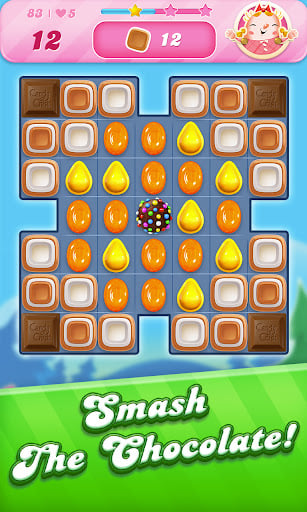
What keeps the game fresh across thousands of levels is the constant introduction of new board elements and obstacles. Chocolate spreads across the board if not cleared. Liquorice locks candies in place. Meringue requires multiple matches to break through. Conveyor belts move candies around the board. Popcorn expands when matched next to it. Each new element changes the strategic landscape, forcing players to adapt their approach and learn new techniques.
Boosters and Power-Ups
Candy Crush offers a range of boosters that give players extra tools to tackle difficult levels. The Lollipop Hammer destroys a single candy, the Free Switch swaps any two adjacent candies regardless of whether they match, and the Color Bomb booster places a Color Bomb on the board. Extra moves can be earned or purchased, and special pre-game boosters provide advantages from the start of a level.
The booster system serves multiple purposes: it provides a safety valve for frustrating levels, creates a resource management meta-game, and drives the game's monetization. Crucially, boosters are available through both gameplay and purchase, ensuring that patient free-to-play players can accumulate them over time while those willing to spend can access them immediately.
By the Numbers
Candy Crush Saga has been downloaded over 3 billion times since launch. At its peak, the game had over 93 million daily active players. King (now part of Activision Blizzard King) was acquired by Activision for $5.9 billion in 2016, largely on the strength of the Candy Crush franchise.
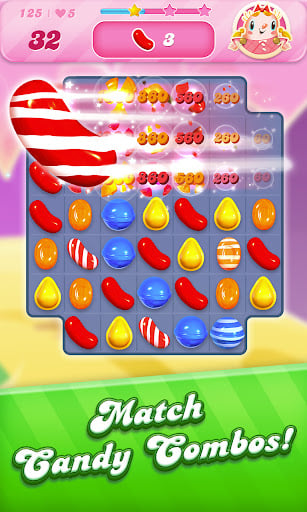
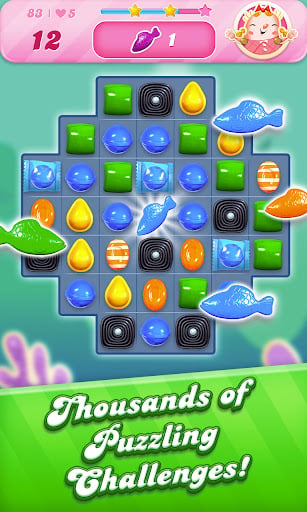
Gameplay screenshots
Social Features: Playing Together
Candy Crush Saga was one of the first mobile games to deeply integrate social features. The game's map shows friends' progress, creating gentle competition as players try to stay ahead of their social circle. Friends can send and receive lives (the game's energy system), reducing wait times and encouraging daily logins. Leaderboards for each level add a competitive element that motivates replaying levels to improve scores.
These social features were initially tied to Facebook, which played a crucial role in the game's viral growth. The visibility of Candy Crush on Facebook feeds, with friends requesting lives, sharing accomplishments, and appearing on the game map, served as organic advertising that drove millions of new installs. This social integration model became a template for countless mobile games that followed.
The Monetization Model
Candy Crush Saga's free-to-play monetization model has been both praised and criticized. The game is entirely free to download and play, with monetization primarily through the purchase of boosters, extra lives, and additional moves. The lives system limits the number of consecutive failures before players must wait for lives to regenerate (or purchase more), creating natural play session breaks.
What makes Candy Crush's monetization notable is its patience. The game never forces purchases — every level can theoretically be completed without spending money. Instead, it creates situations where spending feels helpful rather than mandatory. This approach has proven remarkably effective, as the game consistently ranks among the top-grossing mobile apps despite being playable entirely for free.
Player Psychology
Understanding Candy Crush's enduring appeal requires examining the psychological principles that underpin its design. The game leverages several well-documented cognitive phenomena to create an experience that feels rewarding and compelling.
Variable ratio reinforcement, the same principle that makes slot machines addictive, operates through the game's cascade system. Players never know exactly when a cascade will trigger a spectacular chain reaction, and the unpredictability of these moments creates excitement. The near-miss effect, where players fall just one move short of completing a level, motivates retry behavior. And the endowed progress effect, the feeling of having already invested effort, makes quitting feel like losing accumulated progress.
The game's difficulty curve is designed to create what psychologists call a "flow state," that optimal zone between boredom and frustration where engagement is highest. By carefully calibrating challenge levels, Candy Crush keeps players in this zone for remarkably long sessions.
In-game action
Why It's Still Number One
More than a decade after launch, Candy Crush Saga remains the most popular puzzle game on mobile platforms. Several factors contribute to this remarkable longevity. The game receives constant updates, with new levels added weekly and seasonal events providing fresh challenges and rewards. The core gameplay loop is timeless: matching colorful pieces is a universally appealing activity that transcends age, culture, and gaming experience.
The game has also evolved with the market. New game modes, live events, and social features have been added over the years, keeping the experience relevant without compromising the simple appeal that made it successful. The Candy Crush franchise has expanded to include multiple spin-offs (Candy Crush Soda Saga, Candy Crush Jelly Saga, Candy Crush Friends Saga), each offering variations on the core formula for players who want something different.
We genuinely believe that Candy Crush Saga's greatest achievement is becoming a habit for its most dedicated players, a daily ritual as ingrained as checking email or scrolling social media. This habitual engagement, built over years of consistent, reliable entertainment, is about not just attracting players but keeping them coming back, day after day, year after year.