One Developer, One Vision, Millions of Players
Geometry Dash is one of indie gaming's most remarkable success stories. Created almost entirely by a single developer, Robert Topala (known as RobTop), and released in August 2013, this rhythm-based platformer has sold millions of copies and built a passionate community that has created over 100 million custom levels. It's a testament to the power of a simple, perfectly executed concept and the creativity that emerges when you give players the tools to build.
At its core, Geometry Dash is deceptively simple: you control a geometric shape (usually a cube) that automatically moves forward through obstacle-filled levels, and your only input is tapping the screen to jump. One wrong tap — or one missed tap — and you crash, restarting the entire level from the beginning. There are no checkpoints in normal mode, no health bars, no second chances. Just you, the rhythm, and pixel-perfect precision.
Gameplay Mechanics: Beyond Simple Jumping
While the tap-to-jump mechanic forms the foundation, Geometry Dash introduces multiple vehicle modes that fundamentally change how you interact with levels. The Ship mode has you flying through narrow corridors, holding to ascend and releasing to descend. The Ball mode reverses gravity with each tap. The UFO mode gives you short boosts of upward thrust. The Wave mode has you navigating tight diagonal corridors. The Robot mode provides variable jump height based on hold duration. And the Spider mode switches between floor and ceiling with each tap.
Levels constantly switch between these modes, requiring players to instantly adapt their timing and input approach. A sequence might have you jumping as a cube, flying through a ship corridor, bouncing as a ball, and weaving through a wave section, all within seconds. This variety keeps every level feeling fresh and ensures that mastering Geometry Dash requires proficiency across all modes.
Speed and Difficulty Portals
Speed portals increase or decrease the pace of the level, with faster speeds dramatically reducing reaction time. Size portals shrink or enlarge your character, changing hitbox dimensions and the feel of movement. These portals are combined with the vehicle modes to create an enormous design space. A level can go from slow-paced cube jumping to hyper-speed wave navigation in an instant, keeping players perpetually on edge.
Iconic Official Levels
Geometry Dash ships with a series of official levels that serve as a progression from beginner to expert difficulty. Stereo Madness, the first level, introduces basic jumping and simple timing. Each subsequent level increases in complexity and speed, introducing new mechanics and more demanding patterns. By the time players reach levels like Electrodynamix, Clubstep, or Theory of Everything 2, they're dealing with intricate sequences that demand frame-perfect precision and deep familiarity with every vehicle mode.
The demon difficulty levels (Clubstep, Theory of Everything 2, and Deadlocked) represent significant milestones in player progression. Completing a demon level is a genuine achievement that can take hours, days, or even weeks of practice. Our team has spent countless hours with these levels, and the satisfaction of finally beating one after hundreds of attempts is a defining experience of Geometry Dash that keeps players coming back to tackle ever-harder challenges.
Community Creation
The Geometry Dash community has created over 100 million custom levels using the built-in editor. Some community levels, like "Bloodbath" and "Tartarus," are considered among the hardest challenges in all of gaming, requiring thousands of attempts and inhuman precision to complete.
The Level Editor: Where Creativity Explodes
Geometry Dash's built-in level editor is arguably its most important feature. The editor provides an extensive toolkit (blocks, spikes, portals, triggers, moving objects, custom colors, and more) that allows players to create levels limited only by their imagination. The editor is powerful enough to create experiences that rival or exceed the quality of official levels, and the community has pushed it far beyond what anyone initially expected.
Community-created levels range from simple practice courses to staggeringly complex artistic showcases. Some creators build levels that tell visual stories through synchronized decoration. Others design puzzle-based levels with custom mechanics created through clever trigger use. And the most extreme creators design "impossible" levels that push human reaction time to its absolute limits, creating challenges that only a handful of players in the world can complete.
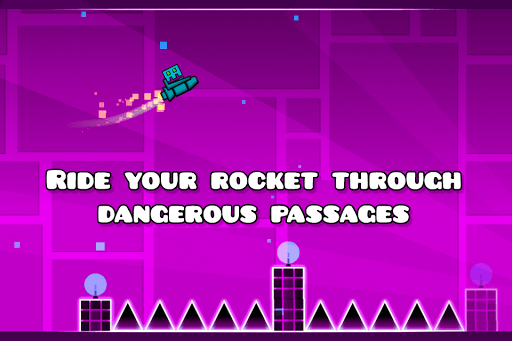
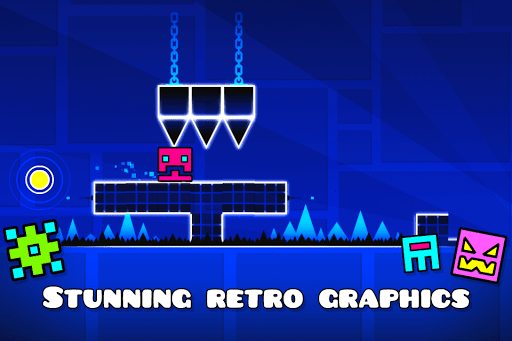
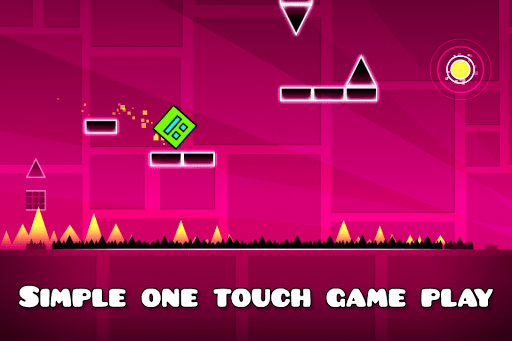
Gameplay screenshots
Music Integration
Music is not just background accompaniment in Geometry Dash. It's the very heartbeat of the experience. Every obstacle, every jump, every transition is synchronized to the music, creating a synesthetic experience where players literally feel the rhythm through their gameplay. The official levels use tracks by artists from the Newgrounds music community, and the level editor allows creators to use any track from Newgrounds' vast library.
This music integration transforms Geometry Dash from a platformer into something closer to a rhythm game. Players learn levels partly through muscle memory but also through musical cues — a bass drop signals a speed change, a melody shift indicates a vehicle mode switch. The result is a deeply satisfying connection between audio and gameplay that few other games achieve.
Practice Mode and Mastery
Practice mode is essential to the Geometry Dash experience. It allows players to place checkpoints throughout a level, practicing specific sections without having to replay the entire level from the beginning. This transforms the learning process from frustrating repetition into targeted skill-building, letting players isolate difficult segments and practice them until they achieve consistency.
The transition from practice mode to normal mode, where all checkpoints disappear, is where the real challenge lies. Players must string together every section they've practiced individually into one continuous, flawless run. This requires not just mechanical skill but also mental endurance and focus, as a single lapse in concentration during a 90-second level means starting over entirely.
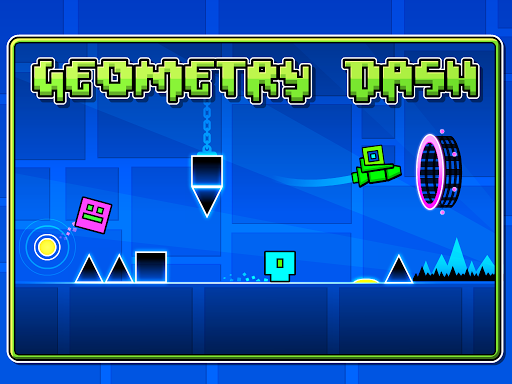
In-game action
The 2.2 Update and Beyond
The long-awaited 2.2 update, released after years of development, represented the largest content update in Geometry Dash's history. It introduced new game modes (the Swing mode), a platformer mode (with free movement and full control), a level component system, camera controls, new triggers, and numerous quality-of-life improvements. The update reinvigorated the community and demonstrated RobTop's continued commitment to expanding the game.
In our honest assessment, Geometry Dash's enduring appeal lies in its perfect simplicity and infinite depth. The controls couldn't be simpler (one tap!) but the challenges couldn't be more demanding. The community couldn't be more creative, and the satisfaction of conquering a level that seemed impossible couldn't be more rewarding. It's a game that distills gaming to its purest essence: challenge, perseverance, and triumph.