Where Strategy Meets Whimsy
Plants vs. Zombies is one of those rare games that achieves perfection within its genre. Created by George Fan at PopCap Games and originally released in May 2009, it took the tower defense genre (traditionally associated with complex interfaces, steep learning curves, and military aesthetics) and transformed it into something universally accessible, endlessly charming, and surprisingly deep. The result was a game that appealed to hardcore strategists and casual players alike, selling millions of copies and spawning a franchise that continues to thrive today.
The premise is delightfully absurd: zombies are invading your backyard, and your only line of defense is an army of sentient plants with unique combat abilities. Sunflowers generate the sun resources you need to plant more defenders. Peashooters fire projectiles at approaching zombies. Wall-nuts absorb damage with their hardy shells. And the roster expands from there into dozens of creative, characterful plants that each solve different strategic challenges.
George Fan's Design Philosophy
The genius of Plants vs. Zombies begins with its creator's design philosophy. George Fan set out to create a tower defense game that anyone could enjoy, including people who had never played a strategy game before. Every design decision reflects this goal, from the horizontal lane-based layout (far more intuitive than traditional grid-based tower defense) to the gradual introduction of new plants and zombies that ensures players are never overwhelmed.
Fan has spoken extensively about his approach to game design: introduce one new concept at a time, give players a safe space to learn that concept, then combine it with previously learned mechanics to create emergent challenges. This philosophy is evident throughout Plants vs. Zombies, where each new level feels like a natural evolution rather than an arbitrary difficulty spike. The game teaches by playing, not by lecturing, and this elegance is a major reason for its universal appeal.
The Plant Arsenal
The plant roster in Plants vs. Zombies is, in our view, a masterclass in character design, both visually and mechanically. Each plant is instantly recognizable, personality-filled, and serves a clear strategic purpose.
The Essential Plants
- Sunflower: The backbone of every garden, producing sun resources that fund your entire defense. Protecting your Sunflowers is the first strategic lesson the game teaches.
- Peashooter: The basic offensive plant, firing peas at zombies in its lane. Simple but effective, and the baseline against which all other offensive plants are measured.
- Wall-nut: A durable defensive plant that absorbs enormous amounts of damage. Placing Wall-nuts strategically to buy time for your offensive plants is a fundamental tactic.
- Cherry Bomb: An instant-use explosive that destroys all zombies in a 3x3 area. Its high sun cost and single-use nature make it a panic button: powerful but expensive.
- Snow Pea: Fires frozen peas that slow zombies, giving your defense more time to deal damage. A crucial upgrade from the basic Peashooter.
Advanced Plants
As the game progresses, increasingly specialized plants become available. The Chomper devours zombies whole but is vulnerable while chewing. The Jalapeno incinerates an entire lane. The Lily Pad enables planting on water in pool levels. The Cactus attacks ground and air zombies. Each new plant opens strategic possibilities and provides answers to specific zombie threats, creating a constantly expanding toolkit that keeps the gameplay fresh across dozens of hours.
Zombie Varieties: An Endless Parade
The zombie roster is equally creative and strategic. Basic zombies shamble forward predictably, but the game quickly introduces variations that demand tactical adaptation. Conehead Zombies have extra durability. Pole Vaulting Zombies leap over your first line of defense. Football Zombies charge at high speed. Digger Zombies tunnel underground to attack from behind. And the Zomboni drives an ice-resurfacing machine that flattens plants in its path.
Each new zombie type presents a puzzle: how do you modify your garden layout to counter this specific threat while maintaining your defense against everything else? The best levels combine multiple zombie types in ways that require creative solutions, forcing players to think about their plant selection and placement in increasingly sophisticated ways.
Awards and Recognition
Plants vs. Zombies won over 30 Game of the Year awards upon release. It has been downloaded over 100 million times across all platforms and spawned a franchise including sequels, spin-offs, and the Garden Warfare shooter series.
Gameplay screenshots
Adventure Mode: A Perfectly Paced Campaign
The main Adventure Mode spans 50 levels across five distinct environments: Day (front yard), Night (introduces mushrooms), Pool (adds water lanes), Fog (limited visibility), and Roof (plants slide and angles matter). Each environment introduces new mechanics and plant types, and the progression from sunny backyard to moonlit rooftop is both narratively satisfying and mechanically engaging.
The pacing of Adventure Mode is exemplary. New plants are introduced at a rate that allows players to experiment with each one before the next arrives. Difficulty ramps gradually but persistently, with occasional "breather" levels that provide a sense of mastery before introducing the next challenge. From our experience playing through the entire campaign, the result is a journey that feels like a complete, satisfying experience from start to finish, which is a rare achievement in any game.
Mini-Games, Puzzles, and Survival
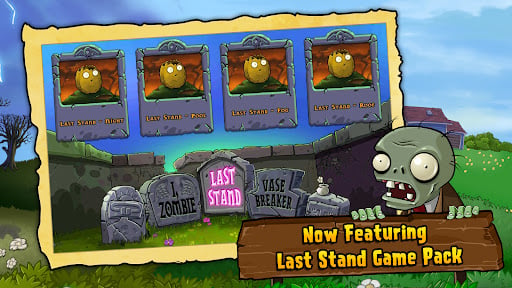
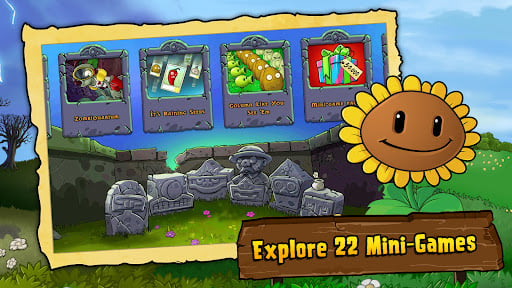
Beyond the main Adventure, Plants vs. Zombies offers a wealth of additional content. Mini-games present unique challenges with modified rules, like bowling with Wall-nuts, playing as the zombies, or defending with randomly assigned plants. Puzzle mode offers I, Zombie (where you play as the zombies planning attacks) and Vasebreaker (breaking mystery vases to reveal plants and zombies). Survival Mode tests endurance with escalating waves that push strategies to their limits.
The Zen Garden
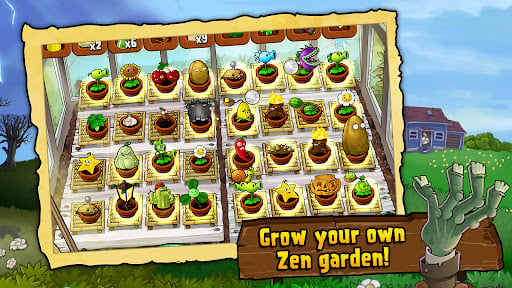
The Zen Garden is a peaceful counterpoint to the strategic intensity of combat. Players collect plants during gameplay and tend them in a virtual garden, watering them, providing fertilizer, and watching them grow. It's a simple but effective relaxation mechanic that provides coins for use in the game's shop and gives players a gentle reason to check in daily. We think it's worth mentioning that the Zen Garden represents the game's broader philosophy: moments of calm are just as important as moments of action.
In-game action
Lasting Legacy
Plants vs. Zombies' influence on game design cannot be overstated. It democratized the tower defense genre, proved that strategic games could be charming and funny, and established a template for how to teach complex mechanics through elegant level design. In our honest assessment, George Fan's creation remains a benchmark, a game so perfectly designed that it feels as fresh and engaging today as it did at launch, and a reminder that the best games are built on ideas, not technology.