The Game That Built an Empire
There's a particular kind of nostalgia that hits when you hear the Clash of Clans theme music. That triumphant horn blare, the medieval drums — for millions of players worldwide, it's the soundtrack to countless hours spent upgrading walls, training troops, and planning raids. Clash of Clans didn't just define a genre; it helped define what mobile gaming could be. And remarkably, more than twelve years after its August 2012 launch, it's still evolving, still surprising, and still commanding the attention of tens of millions of active players.
Supercell's flagship title is a study in how to build something that lasts. In an industry where most mobile games burn bright for a year and fade, Clash of Clans has burned steadily for over a decade. Understanding how requires looking at both where it started and how dramatically it has grown.
2012–2014: The Foundation Years
When Clash of Clans first appeared on iOS in 2012 (Android followed in 2013), the game was almost startlingly simple compared to what it would become. You had a village. You built defenses. You trained troops. You raided other players' villages to steal their resources. That was essentially it.
But that simplicity was the genius. The core loop — build, upgrade, attack, defend — was instantly understandable and deeply satisfying. Placing a mortar in just the right spot to cover your storages, watching a horde of barbarians crash against your walls, the thrill of finding a base with exposed resources just waiting to be plundered. These were primordial gaming pleasures, and Supercell had distilled them into a touchscreen experience that felt effortless.
The early game had just a handful of troop types: Barbarians, Archers, Giants, Goblins, and Wall Breakers. The Town Hall went up to level 10. There was no Clan Wars, no Builder Base, no Clan Capital. And honestly? It was already one of the best games on mobile. Sometimes the strongest foundation is the simplest one.
The Social Hook: Clans
What elevated Clash of Clans from good to phenomenon was the clan system. Joining a clan — or building one — transformed the game from a solo village-builder into a social experience. Clan chat became a gathering place. Donating troops became a form of currency and respect. And when Clan Wars arrived in 2014, everything changed.
Clan Wars: The Update That Changed Everything
If there's a single moment that cemented Clash of Clans as a permanent fixture in mobile gaming, it was the introduction of Clan Wars in April 2014. The concept was elegant: two clans matched against each other, each member attacking a counterpart on the opposing side, with the clan scoring the most stars winning the war.
Clan Wars turned Clash of Clans from a game you played into a game you strategized about. Suddenly, base design wasn't just about protecting your own loot — it was about creating layouts that could withstand coordinated attacks from skilled opponents. Attack planning became a team activity, with clan members discussing strategies, sharing replays, and calling targets. The chat-room dynamic that had been fun before became essential.
For fans of Clash Royale, which Supercell launched in 2016, the competitive DNA is clearly inherited from Clan Wars. The same studio that understood competitive team dynamics in Clash of Clans distilled it into a faster, more intense format with Clash Royale. Both games benefit from that shared design philosophy.
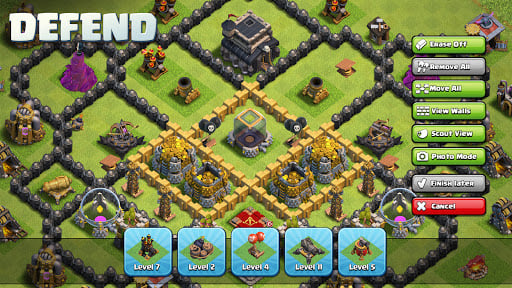
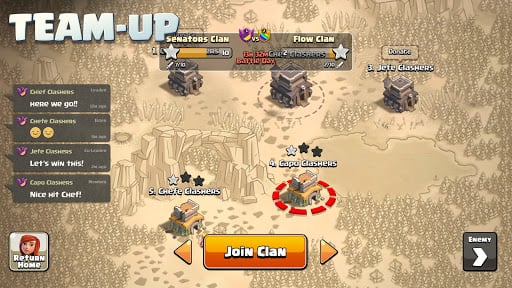
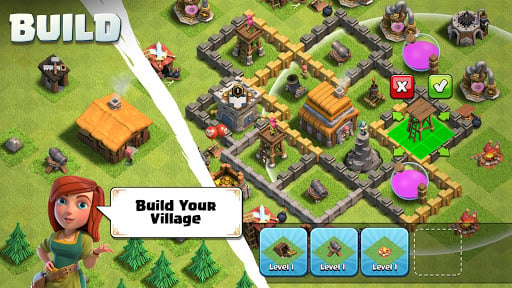
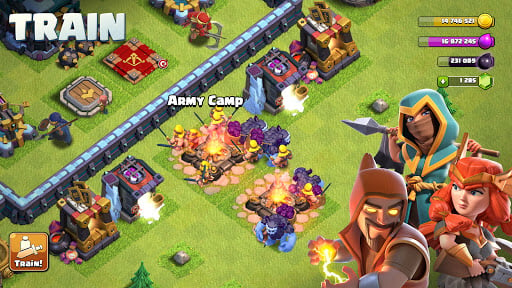
From village building to all-out clan warfare — Clash of Clans has grown beyond recognition
The Evolution of Attack Strategy
One of the most fascinating aspects of Clash of Clans' longevity is how the offensive meta has evolved. In the early days, mass-dragon attacks dominated — spam dragons, deploy rage spells, watch them burn everything. It was effective and required minimal planning.
As the game introduced new troops and defenses, attacks became progressively more sophisticated. GoWiPe (Golems, Wizards, P.E.K.K.A.s) emerged as a methodical ground strategy. LaLoon (Lava Hounds and Balloons) became the premier air attack. Hybrid attacks mixing Hog Riders and Miners required precise deployment timing. Queen Walks, using the Archer Queen's ability to walk the perimeter of a base clearing defenses, added a new dimension of skill expression.
Today, high-level attacks in Clash of Clans are genuinely complex. A well-executed attack at Town Hall 16 involves multiple phases: a funnel creation phase to guide troops, a kill squad to eliminate key defenses, a main army deployment timed to pathing predictions, and spell usage coordinated down to the second. It's not an exaggeration to say that mastering Clash of Clans attacks requires more strategic thinking than many full-priced strategy games.
Clash of Clans Through the Ages
2012: Launch with TH1-10, basic troops, clan system
2014: Clan Wars revolutionize the game; TH11 and Grand Warden added
2017: Builder Base introduces a separate village with new mechanics
2020: Super Troops, Siege Machines expand strategic options
2022: Clan Capital — clans collaborate to build and defend a shared capital
2024-2026: TH16, new hero equipment, Clan Wars League refinements
Builder Base: The Bold Experiment
In 2017, Supercell made its most divisive design decision: the Builder Base. A separate island with its own troop roster, its own upgrade path, and a versus-battle system where you and an opponent simultaneously attack each other's bases. The winner is whoever gets more destruction or stars.
The community's reaction was mixed, and honestly, I understand why. Builder Base felt disconnected from the main game for years. But Supercell listened, iterated, and with the Builder Base 2.0 update, finally integrated the two halves more meaningfully. The second builder, earned through Builder Base progression, became essential for serious main-village advancement. What started as an awkward side project evolved into a complementary experience.
It's a pattern that defines Supercell: they ship features that aren't perfect, they listen to feedback, and they iterate until they get it right. It's the same approach that drove Brawl Stars through a complete redesign during its beta period before becoming one of mobile gaming's biggest hits.
Clan Capital: The Social Renaissance
If Clan Wars was the first revolution, Clan Capital was the second. Introduced in 2022, Clan Capital gave clans a shared village to build collectively — each member contributing resources and effort toward upgrading a massive, multi-district capital. Raid Weekends pit your clan's capital against others in cooperative attacks where the entire clan participates.
Clan Capital solved a problem that had been growing for years: at the highest levels, Clan Wars could feel like a small group of elite attackers carrying the rest. Clan Capital democratized contribution. Every member, regardless of Town Hall level, could help build, and every member participated in raids. It reinvigorated clan communities that had grown stale and gave newer players a genuine sense of belonging and contribution.
Clan Capital — where entire clans collaborate to build something greater than any individual village
The Supercell Ecosystem
Clash of Clans doesn't exist in a vacuum. It's the anchor of Supercell's interconnected gaming universe. Characters like the Barbarian, Archer, and Wizard appear across multiple Supercell titles. Clash Royale takes the same characters into a real-time card battle arena. Brawl Stars occasionally features Clash-themed events and skins. There's even a dedicated animated series, Clash-A-Rama, that has accumulated billions of views.
This ecosystem approach keeps the brand alive across demographics. A player might start with Clash Royale's faster format, graduate to Clash of Clans' deeper strategy, and play Brawl Stars for quick competitive sessions. The games complement rather than cannibalize each other — a rare achievement in mobile gaming.
Monetization: The Gold Standard of Fairness
Let's address the elephant in the room: Clash of Clans has a gem system that allows players to speed up upgrade timers and purchase resources. Early in the game's life, this could feel pay-to-win. A player who spent heavily could max their base while free-to-play players ground through weeks-long upgrade times.
Over time, Supercell has dramatically improved the free-to-play experience. Season Challenges provide excellent rewards for active players. The Gold Pass (a modest monthly investment) accelerates progression substantially. Magic Items allow strategic time-skipping. And critically, Clan Wars League rewards Clan War League medals that can be spent on hero upgrades and other valuable resources, giving competitive players a meaningful progression shortcut that doesn't cost money.
Is it still possible to spend thousands of dollars on Clash of Clans? Technically, yes. But is it necessary? Absolutely not. The game rewards patience, and frankly, part of the satisfaction is watching your base evolve over months and years. Compared to predatory monetization in something like the match-3 genre — though we love Candy Crush for what it is — Clash of Clans is remarkably fair.
Playing Clash of Clans in 2026
Here's what I find most remarkable about Clash of Clans in 2026: it's still growing. Not just maintaining — growing. Town Hall 16, hero equipment systems, new troop levels, Clan Wars League refinements, and quality-of-life improvements continue to roll out. The competitive scene remains active, with the Clash of Clans World Championship providing a stage for the game's most skilled players.
New players starting today face an interesting proposition. There's more content than ever, and the path from TH1 to max is long. But Supercell has compressed early-game progression significantly, with events and rewards that accelerate new players through the lower town halls quickly. You'll reach the "meat" of the game — Clan Wars, strategy-intensive attacks, and meaningful clan participation — faster than players did in 2012.
For returning players — the ones who played in 2014, drifted away, and are now curious about what's changed — the answer is: everything and nothing. The core loop is the same satisfying build-and-battle rhythm you remember. But the depth, the variety, and the social features have expanded enormously. Coming back to Clash of Clans after a hiatus is like returning to a hometown that's grown into a city. The streets are familiar, but there's so much more to explore.
Legacy and Impact
It's difficult to overstate Clash of Clans' impact on mobile gaming. It proved that mobile games could sustain massive player bases for years, not months. It demonstrated that free-to-play monetization and player-friendly design weren't mutually exclusive. It created a competitive ecosystem that paved the way for mobile esports. And it launched Supercell into the stratosphere as one of the most successful gaming companies in history — a Finnish studio of a few hundred people generating revenues that rival studios with thousands of employees.
More personally, Clash of Clans taught a generation of gamers what community looks like in a mobile game. The clans people joined in 2013 and 2014 — some of those clans still exist today, with members who have been playing together for over a decade. In an era of disposable digital entertainment, that kind of lasting community is rare and precious. Clash of Clans earned it by being a game worth coming back to, week after week, year after year. And in 2026, that hasn't changed.