A Block-Building Revolution
When Markus "Notch" Persson released the first public version of Minecraft in May 2009, few could have predicted that a game built entirely from textured cubes would go on to become the best-selling video game of all time. With over 300 million copies sold across every major platform, Minecraft has transcended the label of "game" and become a cultural institution — a digital canvas used by children, architects, educators, and even entire governments to build, learn, and connect.
What makes Minecraft so enduringly compelling is its radical simplicity married to limitless depth. On the surface, players break and place blocks in a procedurally generated three-dimensional world. Beneath that simplicity lies a game that can be as relaxing or as complex as the player desires, from peaceful flower-garden builds to functional computers constructed entirely within the game's redstone logic system.
Gameplay Modes: Something for Everyone
One of Minecraft's greatest strengths is the variety of ways it can be played. The game ships with several distinct modes, each offering a fundamentally different experience while sharing the same blocky DNA.
Survival Mode
Survival is the quintessential Minecraft experience. Players spawn in a randomly generated world with nothing and must gather resources, craft tools, build shelter, and fend off hostile creatures that emerge at night. The progression loop, from punching trees to mining diamonds to battling the Ender Dragon, creates a compelling arc that has kept players engaged for over a decade. Hunger management, health systems, and an increasingly dangerous underworld (the Nether) add layers of strategic depth that reward careful planning and exploration.
Creative Mode
Creative Mode removes all survival mechanics, giving players unlimited resources, the ability to fly, and invulnerability. This mode transforms Minecraft into a pure construction sandbox, essentially a digital LEGO set with infinite pieces. Players have used Creative Mode to recreate entire cities, design pixel art spanning thousands of blocks, and build architectural marvels that rival real-world structures in complexity. From our perspective, it's this mode that has attracted professional architects, urban planners, and artists to the platform.
Adventure Mode
Adventure Mode restricts certain gameplay actions to enable community-created experiences. Players cannot break or place blocks unless they use specific tools, making it ideal for custom maps, RPG-style quests, and narrative-driven experiences. This mode has spawned an entire sub-community of map-makers who design intricate puzzle dungeons, story campaigns, and competitive challenges.
Hardcore Mode
For those who crave a true challenge, Hardcore Mode offers permanent death: one life, no respawns. The world is locked to the hardest difficulty setting, and every encounter with a Creeper or lava flow carries genuine stakes. This mode has become a staple of streaming content, where the tension of a single-life run creates compelling viewing and has fueled some of the most-watched gaming moments on platforms like YouTube and Twitch.
Redstone: The Engineer's Playground
Perhaps no feature exemplifies Minecraft's depth better than redstone. This in-game material functions like electrical wiring, allowing players to create circuits, logic gates, and automated machinery. What started as a simple mechanism for opening doors has evolved into a fully functional programming environment.
Players have built working calculators, binary computers, musical sequencers, and even functional hard drives using redstone. The complexity possible within this system rivals real-world electrical engineering, making Minecraft a surprisingly effective tool for teaching computational thinking and basic programming concepts. Universities have used redstone circuits to demonstrate logic gate operations, and countless young engineers have gotten their start tinkering with redstone contraptions before ever touching a line of code.
Did You Know?
The largest functioning redstone computer ever built in Minecraft contained over 250,000 individual blocks and could perform basic arithmetic operations. It took a team of builders more than six months to complete.
Multiplayer and Community Servers
Minecraft's multiplayer experience extends far beyond simply sharing a world with friends. The game's server ecosystem is vast and varied, hosting everything from small private survival servers to massive networks with millions of monthly players. Servers like Hypixel have become gaming institutions in their own right, offering dozens of unique minigames, from competitive PvP arenas to cooperative dungeon crawlers, all running within Minecraft's engine.
The server community has also given rise to an entire economy of content creation. Custom plugins, mods, and resource packs are developed by thousands of independent creators, constantly expanding what's possible in the game. Server administrators build complex economies, governance systems, and social structures that mirror real-world communities, creating experiences that go far beyond traditional gaming.
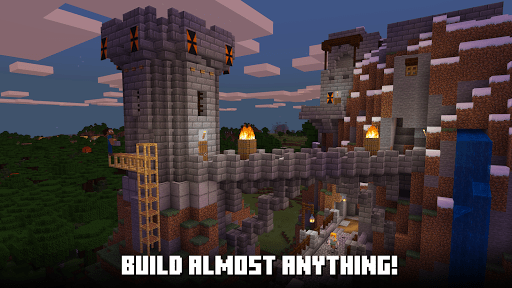
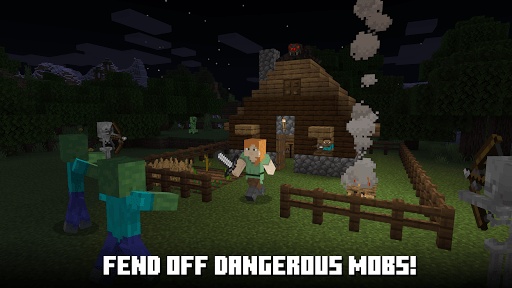
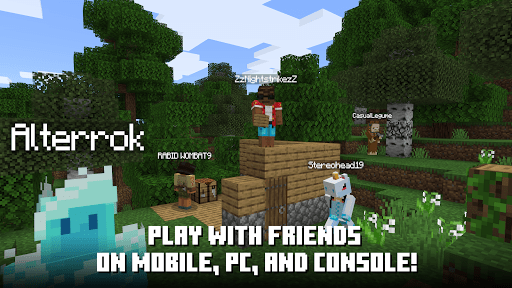
Gameplay screenshots
Cross-Platform Play
With the unification of Minecraft's codebase under the Bedrock Edition, players can now connect across PC, consoles, and mobile devices seamlessly. This cross-platform functionality means a player on an iPad can build alongside someone on an Xbox or a Windows PC, breaking down the barriers that traditionally separated gaming communities. The Java Edition continues to thrive on PC, offering deeper modding capabilities and a distinct community, while Bedrock brings accessibility and connectivity to the broadest possible audience.
Education Edition: Learning Through Play
Minecraft Education Edition represents one of the most successful deployments of game-based learning in educational history. Used in over 115 countries, the Education Edition provides specialized tools for classroom environments, including cameras for documentation, portfolio tools for assessment, and curated lesson plans covering subjects from mathematics and history to chemistry and coding.
Teachers use Minecraft to teach everything from ancient history (students can recreate historical civilizations) to chemistry (the game includes an element constructor that mirrors the periodic table). The immersive, interactive nature of the platform keeps students engaged in ways that traditional textbooks simply cannot, and research has shown measurable improvements in collaboration skills, creative problem-solving, and digital literacy among students who use the platform regularly.
The Modding Community
Minecraft's modding community is arguably the largest and most active in all of gaming. Through the Java Edition's open architecture, modders have created tens of thousands of modifications that fundamentally alter the game. Popular mod packs like Feed The Beast, Tekkit, and RLCraft add entirely new dimensions, creatures, technologies, and gameplay systems. Some mods introduce magic systems with hundreds of spells, while others add realistic physics engines, advanced agriculture simulations, or space exploration mechanics.
The modding ecosystem has also served as a launching pad for countless game developers. Many successful indie games and studio hires trace their origins back to Minecraft modding, where creators learned programming, game design, and project management in a supportive community environment.
Recent Updates and Evolution
Minecraft continues to receive substantial updates that reshape the experience. The Caves & Cliffs update (released in two parts across 2021) dramatically overhauled the game's terrain generation, introducing massive cave systems, lush caves, dripstone formations, and towering mountain ranges that make exploration more rewarding than ever. The Wild Update brought the deep dark biome, the fearsome Warden mob, and ancient cities filled with lore and loot.
More recent updates have continued this trend of adding meaningful content. New biomes, creatures, and crafting systems arrive regularly, ensuring that veteran players always have something new to discover. Our reviewers appreciate that the game's update cadence strikes an admirable balance between preserving the core experience and introducing fresh mechanics that keep the world feeling alive and surprising.
Cultural Impact and Legacy
Minecraft's cultural significance extends well beyond gaming. The game has inspired an animated series, educational programs, museum exhibitions, merchandise lines, and even a feature film in development. Its visual style, those distinctive blocky pixels, has become iconic, instantly recognizable even to people who have never played the game.
When Microsoft acquired Mojang Studios for $2.5 billion in 2014, many feared the acquisition would compromise the game's indie spirit. Instead, Microsoft largely allowed Minecraft to continue evolving on its own terms while providing resources for expansion into new markets and platforms. In our view, the acquisition has arguably strengthened the game, enabling larger updates, better server infrastructure, and the development of the Education Edition, all while maintaining the creative freedom that made Minecraft special in the first place.
Why Minecraft Appeals to All Ages
Few games successfully bridge generational gaps the way Minecraft does. Children as young as five can enjoy placing colorful blocks in Creative Mode, while teenagers design complex redstone machines and compete on PvP servers. Adults find satisfaction in ambitious building projects and nostalgic survival runs, and seniors have embraced the game as a way to stay mentally engaged and connected with younger family members.
This universal appeal stems from Minecraft's fundamental design philosophy: provide tools, not objectives. By refusing to impose a single "correct" way to play, Minecraft accommodates every play style and skill level. There is no fail state in Creative Mode, no time pressure in most game modes, and no learning curve so steep that it excludes newcomers. At the same time, the game's ceiling is effectively limitless. Players who have been building for a decade still discover new techniques and set new goals.
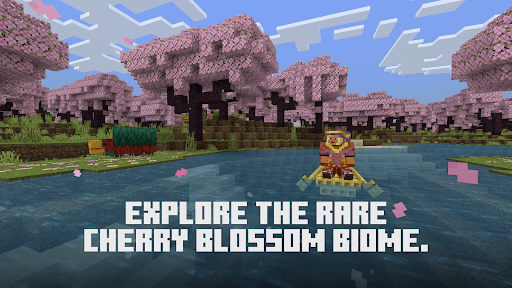
In-game action
The Future of Minecraft
As Minecraft enters its second decade, the game shows no signs of slowing down. With continued updates, a thriving modding community, an expanding esports and content creation scene, and ongoing adoption in educational settings, Minecraft remains as relevant today as it was at launch. The upcoming Minecraft movie promises to introduce the franchise to an even wider audience, while new features and collaborations ensure that the in-game experience continues to evolve.
In our honest assessment, Minecraft's enduring success offers a powerful lesson for the gaming industry: that simplicity, creativity, and community are more valuable than photorealistic graphics or scripted narratives. In a world of fleeting trends and annual sequels, Minecraft stands as a monument to the power of player imagination, a sandbox that truly has no limits.