A Silent Poem Rendered in Impossible Geometry
There are games you play. And then there are games that stay with you — that settle into the quiet corners of your mind and refuse to leave, not because they demanded your attention, but because they earned your reverence. Monument Valley, created by the London-based studio ustwo games, belongs unequivocally to the second category. Released in 2014, it arrived on mobile devices like a whispered secret, and within months, it had fundamentally altered the conversation about what games could be.
I remember the first time I guided Princess Ida through those pastel-colored corridors. The screen was small — just my phone, held in one hand on a quiet afternoon — and yet the world felt immense. Not because of sprawling maps or open-world ambitions, but because every single pixel carried intention. Every shadow, every geometric twist, every moment of silence between footsteps told me that someone had poured genuine love into this creation. That feeling, that sense of encountering art through interaction, hasn't faded even after revisiting the game half a dozen times.
The Art of Impossible Architecture
At its heart, Monument Valley is a puzzle game built around optical illusions and impossible architecture. Drawing heavily from the work of M.C. Escher — the Dutch graphic artist famous for his mathematically inspired woodcuts and lithographs — the game presents structures that could not exist in three-dimensional space. Staircases lead simultaneously up and down. Paths connect at impossible angles. Platforms that appear miles apart are actually touching, if only you rotate your perspective.
The genius of the game lies in how it transforms these visual paradoxes into playable spaces. You guide Ida along pathways by tapping where you want her to go, but the real interaction comes from manipulating the architecture itself. Rotating pillars, sliding platforms, and cranking handles causes the impossible geometry to shift, creating new connections and revealing hidden pathways. What looked like a dead end becomes a bridge. What appeared to be a wall becomes a floor. The game constantly asks you to question your assumptions about space and perspective.
This isn't the kind of puzzle design you'll find in something like Geometry Dash, where reflexes and timing drive the experience. Monument Valley operates on a different frequency entirely. There's no timer. No score. No fail state in any meaningful sense. You simply explore, experiment, and eventually — sometimes through logic, sometimes through intuition — discover the way forward. The puzzles are designed to produce moments of delight rather than frustration, and that design philosophy permeates every interaction.
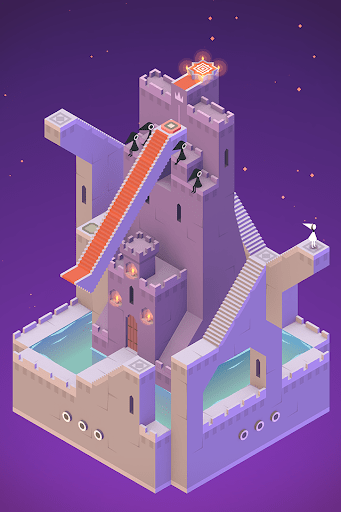
Impossible staircases form the backbone of Monument Valley's spatial puzzles
A Color Palette That Tells Stories
If you were to take a screenshot of any moment in Monument Valley and hang it on a wall, it would pass as fine art. This is not hyperbole. The game's color palette — soft corals, deep teals, warm ambers, cool lavenders — shifts from chapter to chapter, establishing mood and atmosphere with the subtlety of a watercolor painting. Early levels bathe you in warm, inviting tones. Later chapters grow darker, more somber, reflecting the emotional arc of Ida's journey without a single word of exposition.
The visual design extends beyond mere aesthetics. Color functions as a narrative device. When you enter a chapter dominated by cool blues and grays, you instinctively understand that something melancholic is about to unfold. When warm oranges and pinks flood the screen, there's a sense of hope, of resolution. ustwo games understood something that many game developers overlook: visual design isn't decoration. It's storytelling.
This commitment to visual narrative reminds me of the approach taken by Genshin Impact, which similarly uses color palettes to distinguish its regions and convey emotional tonality. But where Genshin achieves this across a sprawling open world, Monument Valley accomplishes it in spaces small enough to fit on a single screen. The economy of expression is staggering.
Sound Design: The Music of Empty Spaces
Monument Valley's audio design deserves its own recognition. The soundtrack, composed by Stafford Beasor, is less a traditional game score and more an ambient soundscape — gentle chimes, soft drones, and crystalline tones that respond to your interactions. Rotating a structure might trigger a melodic phrase. Stepping onto a pressure plate produces a harmonious chord. The game essentially transforms you into an inadvertent musician, creating gentle compositions through the act of solving puzzles.
But perhaps more powerful than the music is the silence. Monument Valley isn't afraid of quiet. Between musical phrases, the game sits in stillness, letting you absorb the architecture, letting the visual beauty speak for itself. In an industry that often mistakes noise for engagement, this restraint is revolutionary.
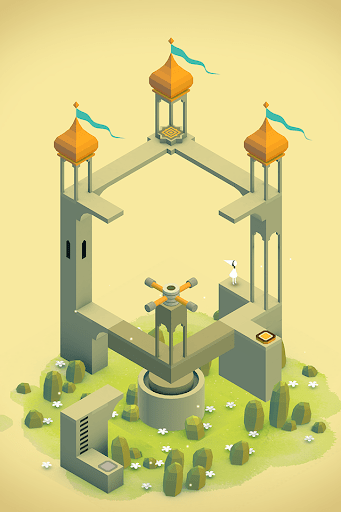
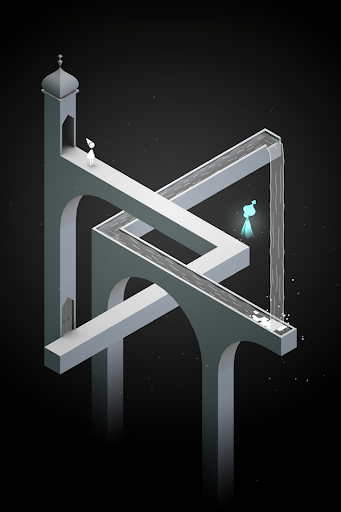
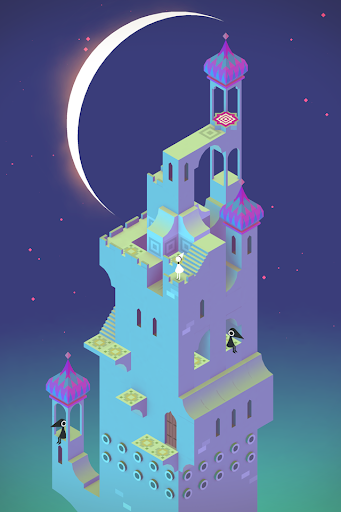
Each chapter introduces a distinct color world with its own emotional atmosphere
The Silent Story of Princess Ida
Monument Valley's narrative is delivered with extraordinary restraint. You play as Ida, a silent princess navigating a series of impossible monuments. Along the way, you encounter the Totem — a friendly, rectangular character who helps Ida reach otherwise inaccessible areas — and the Crow People, mysterious figures who patrol fixed paths and block your progress. Through sparse text, environmental storytelling, and the emotional arc suggested by the shifting visual design, a story of redemption, forgiveness, and sacred geometry unfolds.
I won't spoil the specifics, because the joy of Monument Valley's story lies in how gradually and gently it reveals itself. What I will say is this: the ending moved me. Genuinely. Not with dramatic cutscenes or sweeping orchestral scores, but with a simple visual transformation that recontextualized everything I'd experienced. It's the kind of storytelling that trusts the player's intelligence and emotional maturity, and it's remarkably effective.
Award Recognition
Monument Valley won Apple's Game of the Year in 2014, a BAFTA for Best British Game, and was featured in the Netflix series "House of Cards" when Frank Underwood was seen playing it on his iPad — a moment that introduced the game to millions of non-gamers and sparked a surge in downloads.
Puzzle Design Philosophy: Elegance Over Difficulty
There's a common misconception that great puzzle games must be punishingly difficult. Monument Valley quietly dismantles that assumption. Its puzzles are designed around the principle of elegant discovery rather than brutal challenge. Most players will complete the game in two to three hours, and few will encounter moments of genuine frustration. But this accessibility is a feature, not a flaw.
Each puzzle introduces a new mechanical concept — rotating rings, sliding towers, hidden pathways — and then explores that concept with a series of escalating scenarios before moving on. The game never overstays its welcome with any single idea. Just when you've grasped how a particular illusion works, the game introduces something entirely new, maintaining a sense of constant discovery that carries you through the entire experience.
This design philosophy stands in beautiful contrast to puzzle games like Cut the Rope, which layers complexity through scoring systems and star ratings. Both approaches are valid, but Monument Valley's refusal to gamify its puzzles — there are no points, no grades, no leaderboards — allows the experience to remain meditative and personal.
The Totem: Your Silent Companion
One of the game's most emotionally resonant elements is the Totem, a bright yellow rectangular character who appears in several chapters. The Totem can't speak. It doesn't have eyes or a face. It's literally a geometric shape. And yet, through careful animation and level design, ustwo games imbues this simple rectangle with personality, loyalty, and even something approaching love.
Levels featuring the Totem require you to coordinate the movements of both Ida and her companion, creating puzzles that feel cooperative even though you're controlling both characters. The Totem serves as a platform, a bridge, and sometimes simply a presence — someone (something?) accompanying Ida through her lonely journey. When the Totem sacrifices itself to help Ida progress, the emotional impact is surprisingly powerful. You've lost a friend, and the friend was a rectangle. That's exceptional game design.
Gallery
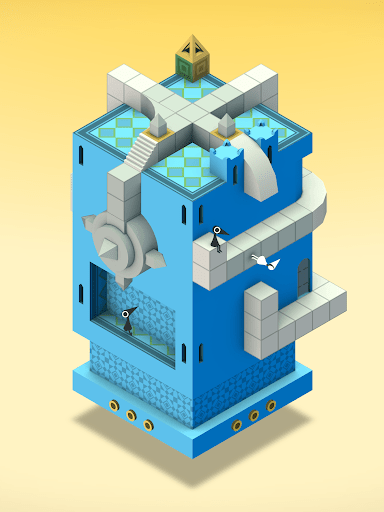
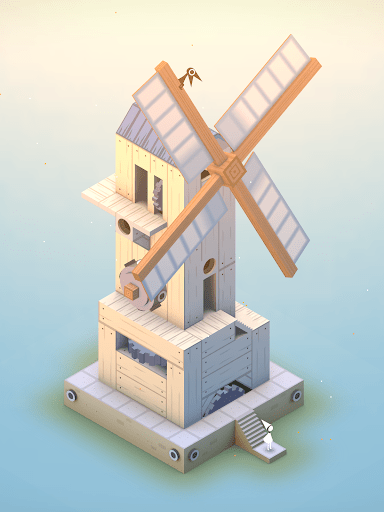
The Totem companion and the intricate monument designs that define each chapter
Legacy and Influence: Gaming as Art
Monument Valley's impact on the mobile gaming landscape cannot be overstated. Before its release, the dominant narrative around mobile games centered on addiction loops, free-to-play monetization, and casual time-wasters. Monument Valley demonstrated that mobile devices could be a canvas for genuine artistic expression — that a game played on your phone during a bus ride could be as emotionally meaningful as a gallery exhibition.
Its influence is visible across the industry. Games like Alto's Odyssey, Florence, and GRIS followed in Monument Valley's footsteps, prioritizing beauty, emotion, and brevity over engagement metrics and retention funnels. The "games as art" movement, which had been largely confined to indie PC titles, found its mobile champion in Monument Valley, and the ripple effects continue to this day.
Monument Valley 2, released in 2017, expanded the formula with a mother-daughter narrative and more complex puzzle mechanics while retaining the original's emotional core. Together, the two games form a duology that stands as one of the most accomplished artistic achievements in the history of mobile gaming.
Is It Worth Playing Today?
Absolutely, unreservedly, yes. Monument Valley has aged beautifully, both visually and mechanically. The art style, being geometric and stylized rather than realistic, is immune to the aging that plagues more technically ambitious games. The puzzles remain as satisfying to solve as they were in 2014. And the emotional resonance — the quiet, contemplative beauty of guiding Ida through her impossible world — is timeless.
If you've never played Monument Valley, I envy you. You're about to experience one of the most beautiful things ever created for a screen. And if you've played it before, consider revisiting it. Like a favorite poem or a beloved painting, Monument Valley reveals new depths with each encounter. It's not just a game. It's a reminder of what this medium can achieve when artists are given the freedom to dream.
Final Verdict
Monument Valley is not just one of the best mobile games ever made — it's one of the most important. It proved that games don't need violence, competition, or addiction mechanics to be compelling. It showed that beauty itself can be a game mechanic. And it demonstrated that a small team with a clear artistic vision can create something that transcends its medium and enters the broader cultural conversation about what art can be.
For anyone who has ever wondered whether games can be art, Monument Valley is the definitive answer. It's a resounding, gorgeous, impossible yes.